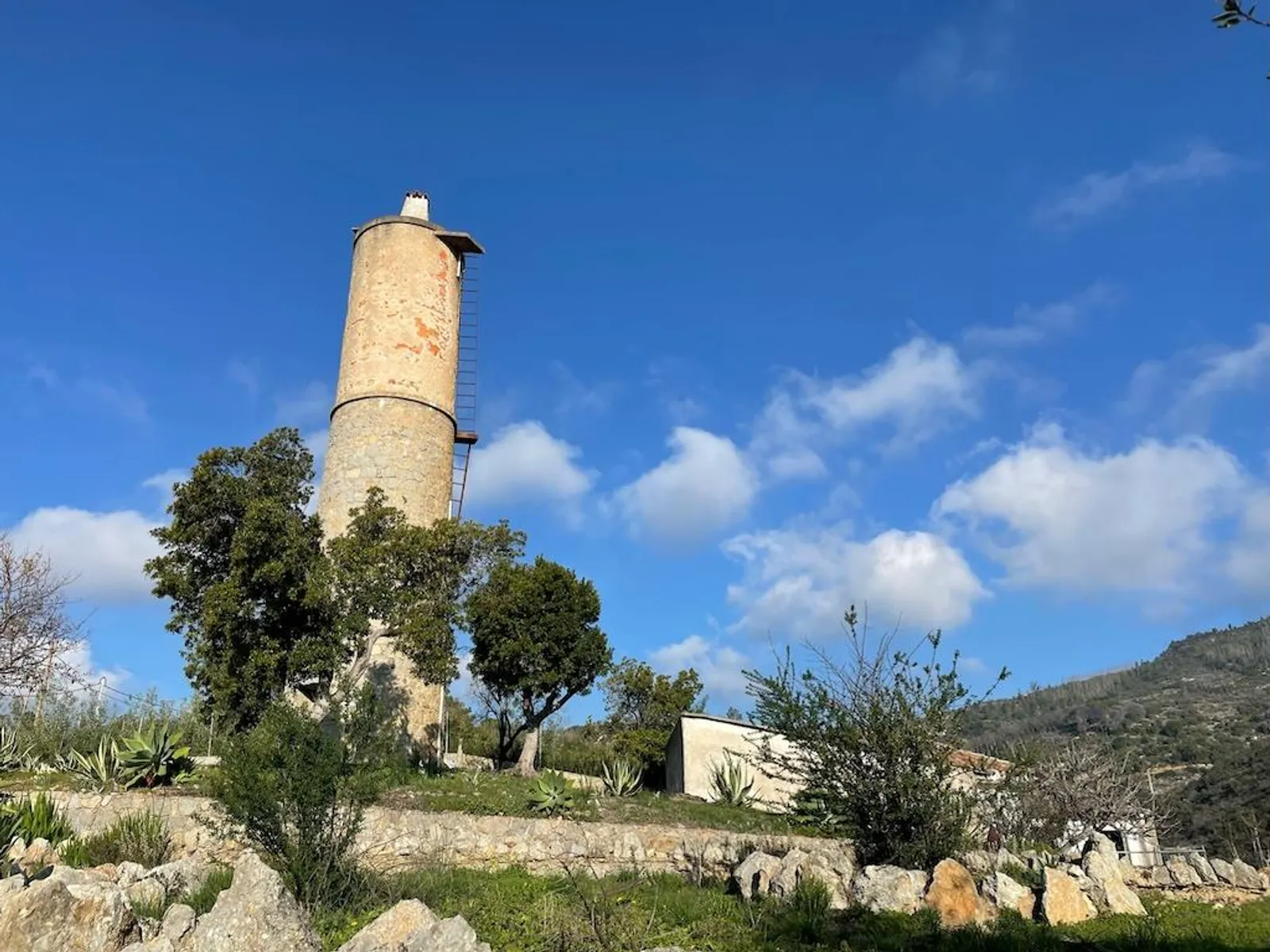
Quinta do Medronhal
History
To all beginnings
“In fact, you don’t collect the materials of life; you live them.” — Alves Redol
I had the privilege of having this work come into my hands. Not in my wildest dreams could I have imagined being lucky enough to do something like this. My love of writing comes from the pleasure of telling stories: it was the stories I heard that gave me the courage to travel the world, to go on stage, to lose myself or heal the wounds in my heart.
The days in Monchique listening to the stories of those who lived through those times, feeling their memories come to life with all the emotions they contain, were so significant for their grandeur that, back in Ericeira when the blank page awaited me, what I found was a maze of doubts and anguish. How could I honour and better tell everything they had told me? I surrendered to the labour of writing as only I know how, by giving myself up. I can’t write without leaving a good part of myself in each line. Whether it’s through dedication, effort or accepting that today this is the best way I know how to do the art I’ve set myself here. I’m not the best or the worst, I’m simply me and the love I put into each word.
Thank you
I want to thank the people who have kindly shared their memories. None of these stories could be told today without the following people.
To thank Joshua and his family for their interest in learning about the history of the farm. It was this thought, this desire that gave rise to the action of making this project happen. I’m grateful for his family’s hospitality in welcoming me to the Quinta, for making themselves known, for the happy mornings with their children’s smiles as they played in the living room, and for offering me their food. And, at the end of the day, for the conversations over a few glasses of wine.
I would also like to thank João, the first person I spoke to, who took the time out of his short lunch break to talk to me. It was this conversation that led me to so many other people. Thanks also to Anabela, from the Recanto restaurant, for her tireless efforts to put me in touch with the right people.
I’d like to thank Eduardo for all the stories he shared, always with enthusiasm and an open heart. Thanks also to his father-in-law, Joaquim Duarte, for joining the conversation.
Finally, a special thank you to Sofia who welcomed me into her home with open arms. Thank you so much for your generosity in sharing memories of the 37 years you worked at the Quinta. It’s not always easy to visit these places of the heart, and she had the courage and kindness to do so. Thank you to Sofia for the brandy she gave me. I didn’t get to taste it, but I’m sure it would have been just as nice.
This work of recovering old, almost extinct stories and keeping them alive on paper and in the minds of all those who read these words has only been made possible by the generosity of these people. Thank you very much.
Foreword
“The quieter you become, the more you are able to hear.” — Rumi (13th century poet, theologian and Sufi)
Quinta do Medronhal has 13.5 hectares (~33 acres) and is located in the Monchique mountains, very close to Caldas de Monchique. The Quinta’s house is situated high up in the hills, overlooking the arbutus, eucalyptus, carob and orange trees. Here the sun rises, marking the silhouettes of the mountains and illuminating every nook and cranny of the slopes. On spring days, the sun shines warm and cosy.
When we arrive at the Quinta we are embraced by silence. This place transmits an immense calm. As the hours go by, you sink deeper into this peace and your mind calms down. And little by little, from the silence, we begin to hear the bees buzzing, the birds chirping, the creaking of the tree trunks, the wind rushing, the lizards hiding and the owls hooting in the night. What was once just silence now becomes a melody sung by all the beings of nature, travelling with us.
I visited the farm in the spring of 2024. There had been a lot of rain followed by a lot of sunshine, giving nature the ingredients it needed to expand in glory: the flowers abounded in a sea of colour; the orange trees were so blooming that the bees wouldn’t stop; an intoxicating citrus scent hung over the hills.
Welcome to Quinta do Medronhal.
Prologue
The first time I met Joshua was in Ericeira, where he shared with me that the former owner of the Quinta was known as the “crazy engineer”. The nickname came from the fact that he made some amazing devices, such as a pump that brought water from the lowest part of the land, where a stream runs, to the house on top of the hill, without the use of electricity. The “crazy engineer” was called Frederico and was married to an Englishwoman called Rosemary. But in fact, they weren’t the last owners. For a few years, the Quinta was transformed into a zoo-park of tropical species called Omega Park.
This brief introduction was enough to pique my curiosity. A few months later I was on the road on my way to Monchique. Beforehand, I searched the internet and went to the library but couldn’t find any information about Quinta do Medronhal or Frederico and his family. I got in touch with the people Joshua had referred me to. Over the phone, I was offered a few appointments, but no information was given over the phone. I left Ericeira for Monchique.
I invite you on this journey. I imagine you’re sitting somewhere on the Quinta, with that landscape embracing you and where these stories once took place. May that tender melody and the mountains take you on a journey through these stories. Stories that took place a long time ago, but exactly where you are today. Where many of the trees you see already existed, the mountains were already there, the bricks in the walls of the house were exactly the same, as were the wooden windows and their glass. It was other people who walked and worked these lands, who certainly had the same questions we have today, the same desires and problems we face today, the same human condition we are all subject to. The only major difference between now and then is the greater level of awareness we should have.
John, the first meeting
João works in the syenite quarry in Monchique. During his lunch break we go to the Águas café, which is near the Intermarché. A simple café serving beers, some savoury snacks, coffee and the most common sandwich in these parts, a ham sandwich. At the counter, I order two beers and we sit round a table. There are three other men in the café: two at the counter chatting and one sitting a metre away from us at a table eating a beautiful ham sandwich. I’m excited by the number of stories João will surely have to tell me. I get my notebook and pen ready; I don’t want anything to slip through the cracks. The investigation begins now.
João explains to me that he never worked at the farm. He knows who the “crazy engineer” was, but little else. He tells me that he knows some people who certainly have more to tell. When he shares these people with me, they are exactly the same ones I have on my list. And there’s a silence between us. I’m overcome with the fear that this investigation has no legs. Out of the silence, João makes a move, turns round and asks loudly: “Do you know anything about the crazy engineer?” The answer is immediate: “Of course, who didn’t know the crazy engineer?”.
A man at the counter begins: “He was always very well dressed in his jacket and shorts, always in white, and then, as he was tall and slim, from a distance you could see who it was and someone would say ‘here comes the crazy engineer’.” The enthusiasm grows and another man says: “The man was very attached to money”. Another hastens to correct him: “But whoever he liked, he gave everything to”. The other replies: “He never gave me anything more than what he owed me, and he demanded a lot, he worked really hard”. There’s a pause and one of the men at the counter looks me in the eye and says: “You need to go to the Recanto [restaurant] and talk to them. There were people there who worked at the Quinta. And also Reis, his father, was in charge there. Oh, and also that lady who lived there in the ruins, I can’t remember her name, but she’ll have a lot to tell you.” He finishes, drinks his beer and leaves. I thank João for his time and availability. I get in the car and drive to the Recanto restaurant.
The lady’s name is Sofia and she lived for over 37 years in one of the houses on the riverbank that are now ruins. I didn’t realise I’d have the chance to talk to her a few days later.
Frederico, the “crazy engineer”
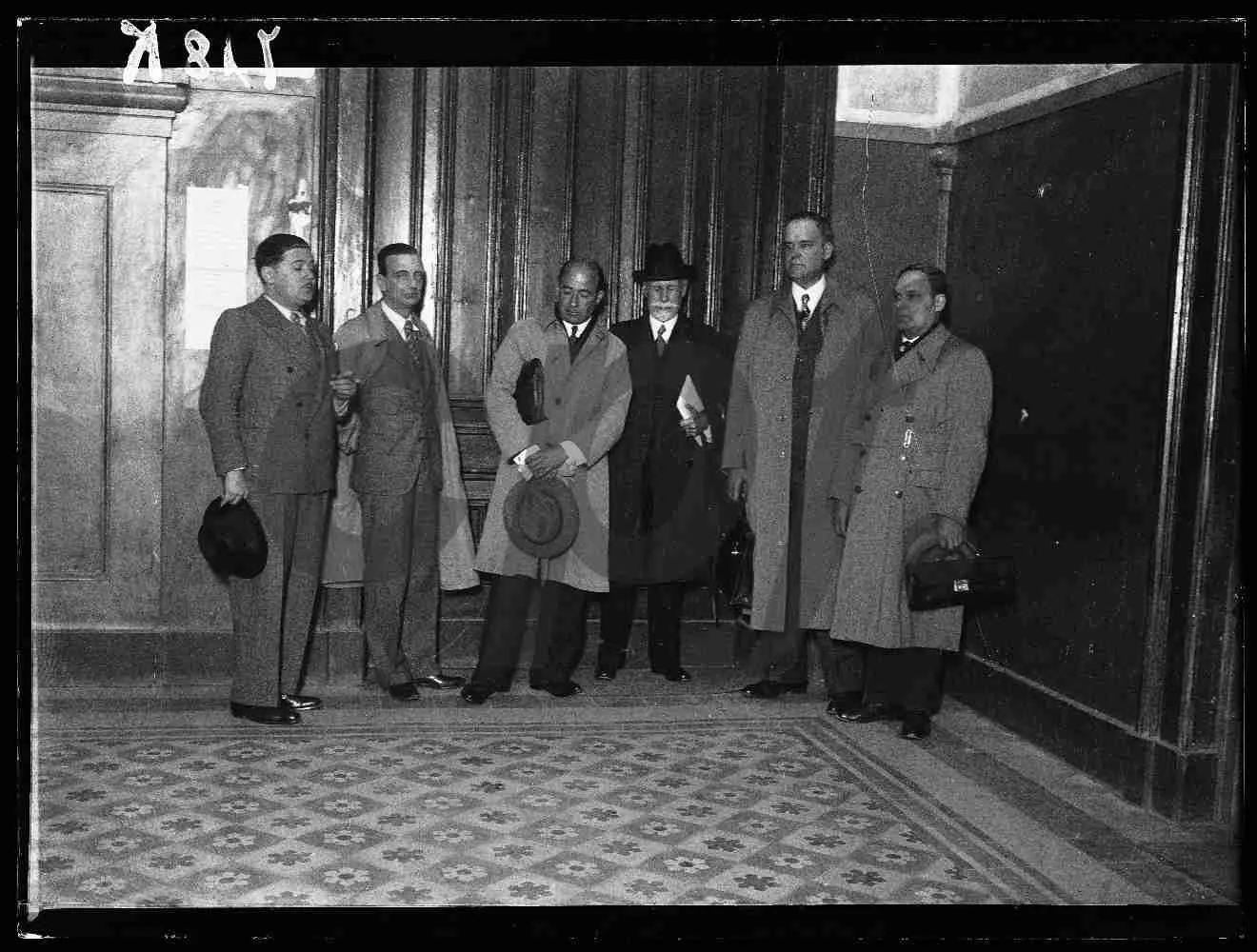
Frederico Ribeiro Neves Bívar Velho da Costa was born in Portimão in 1900, sister of Maria Carlota de Bívar Velho da Costa, children of António de Bívar Moreira de Brito Velho da Costa and Elisa Ribeiro Neves. Frederico’s grandfather was Frederico Moreira de Brito Velho da Costa.
Frederico married Rosemary Fountain Montagu, daughter of Frederik Algabaston Fountain Montagu and Elisa Montagu. They lived together at Quinta do Medronhal, inherited from his Bívar Velho da Costa family. Among the locals, Frederico was known as the “crazy engineer”. Francisco Bívar Velho da Costa was an electrical engineer by training, and those who called him crazy said that he wasn’t crazy at all, “he just had ideas that were way ahead of his time”.
At that time in the Algarve, as in the rest of the country, most of the land belonged to a small number of families. In Monchique, these families were the Mascarenhas and the Bívar Velho da Costa. Frederico Bívar Velho da Costa inherited the Quinta and its land. It was rumoured that he also had income from some flats he rented in Portimão. Frederico and his wife Rosemary’s life was divided between Quinta do Medronhal and a top floor flat with large windows in Portimão.
Rosemary Fountain Montagu, Frederico’s wife, was English and tall. Apparently, she received an important pension, but nobody knows what it was for. In the early days, she spoke little Portuguese, but over the years she improved and mastered the language perfectly. Some say that she liked to hold parties on the estate and invite her family. She had a great affection for animals and spent hours in the swimming pool. She was a woman with ideas ahead of her time, as Eduardo tells us.
Eduardo, the Rosemary episode
At the end of lunchtime, around 2.30pm, I arrive at the Recanto restaurant. I wasn’t just looking for lunch. I had already contacted Anabela Duarte, who works there, and she had told me that Eduardo (her brother-in-law) and Joaquim Duarte (her father) would have stories to tell me. I sit down and order the dish of the day, chicken in the oven with potatoes and salad.
A man approaches the table, puts down the bread and olives and asks me: “So you’re the one who’d like to know about the ‘crazy engineer’?” And I reply: “That’s me, and this chicken is delicious”. The man is Eduardo, who, with a smile, thanks me for the compliment and, without losing his smile, begins to tell me: “Once, when I was about 10 years old, which was about 45 years ago, I used to go to the farm every now and then to do some work. Usually the jobs were for the ‘crazy engineer’, but this time it was his wife, Rosemary.” He lets out a small laugh and continues, “He told me to meet her at the pool. When I got there, I wasn’t surprised to see that Mrs Rosemary was almost naked, or rather without her bathing suit top on. I’d never seen a woman like that. Imagine, I was 10 years old.” He laughs with an expression of innocence and continues, “When she saw me, she wasn’t bothered at all. She spoke to me in her strange Portuguese, as if the whole situation was normal. I was the only one who was confused and didn’t know what to do.”
What Portugal was like in those days
The stories I was told date back to the period between 1950 and 1980. From 1933 until 1974, Portugal had a dictatorial, authoritarian, autocratic and corporatist political regime that lasted for 41 uninterrupted years. It was called the Estado Novo and was overthrown in the Revolution of 25 April 1974. An armed military revolution in which no guns were used and every rifle barrel had a carnation; for this reason, it was also known as the Carnation Revolution.
During the Estado Novo, Portugal lived under severe repression of individual freedoms, with a very religious state and the highest illiteracy rates in Europe. During this dictatorship, women could only work with their husbands’ permission; they earned 40% less than men; they couldn’t be judges, diplomats or policemen; nurses and hostesses couldn’t marry; until 1969, women could only travel abroad with their husbands’ permission.
There was strong censorship: many books, records and songs were censored; it was considered a crime to own a book or record that had been censored by the PIDE (International and State Defence Police); there were political prisoners and the existing Constitution did not guarantee essential rights to citizens, such as education, health, work and housing; any political, association and trade union activity was illegal and controlled by the political police.
In schools, there were no mixed classes, and teachers could beat their pupils and give them punishments that we consider cruel today.
While Europe was preparing for decolonisation, the Estado Novo was intensifying its subjugation of the peoples of the colonies. Angola, Mozambique and Guinea-Bissau demanded their independence and, in response, between 1961-1974, the Estado Novo mobilised 150 thousand men to fight for the subjugation of their peoples. 10,000 Portuguese died, 20,000 were left disabled and 100,000 were victims among the civilians living in the colonies.
Portugal was a country isolated from the world and Europe: isolated politically, intellectually and economically. The government’s protectionist policies, with the aim of encouraging the consumption of national products, imposed high taxes on imported goods. The result was that very few imported products entered the country. This protectionism forced Frederico Velho da Costa to be creative in order to achieve his goals, as we’ll see below.
While Europe, in the midst of the industrial revolution, was innovating with ideas and machinery, Portugal was still stuck with very rudimentary methods and processes. The low cost of labour and the high cost of machinery made it unattractive to risk investing in new machines.
It was a two-speed country: in the urban centres, many people went to university and from there emerged great writers who were recognised in Europe, such as Raul Brandão and Eça de Queirós. Meanwhile, the countryside was made up of people who worked the land, ate only what they grew and wore what they produced without knowing how to read or write and with a strong religious influence.
Frederico, and his fascination with novelties
It is said that Frederico Bívar Velho da Costa found his inspiration in the many magazines he read. Portugal was isolated from the world, but Frederico, on his trips to England, had access to the innovations that emerged at the beginning of the 20th century. He was a pioneer in bringing machines and devices to this corner of the Algarve.
The conversation with Eduardo continues, “He was the first to bring the ‘electric shepherd’. You’d never seen anything like that around here, everyone was amazed,” he finishes, laughing as he remembers those times.
The so-called “electric shepherd” is an electrified fence that is used to surround animals or prevent them from crossing a boundary. Eduardo continues: “There probably isn’t a person here today who doesn’t have an ‘electric shepherd’, but in those days you’d never seen such a thing.” He pauses and continues: “There was also a small tractor that could go anywhere. Instead of wheels, it had caterpillars. All those slopes down to the stream were planted, and the tractor would drive round calmly. It was incredible.”
Eduardo’s enthusiasm grows as he tells stories: “He was also the first to bring the automatic drinking troughs for the cows here. The cows would touch their tongues and the water would fall out. You don’t know how convenient that was.”
And then another story comes to light, “The first time I went there [to the Quinta], I heard a traaaac traaaac,” and continues, “That noise came from a pump that carried water from the stream, way down there, to the water tank tower that is at the entrance to the Quinta.”
The surprising thing is that this pump doesn’t run on electricity, diesel or any other external energy source. The pump uses the water’s own energy, making use of the pressure to transport the water to the top. Today this is a well-known pump, known as a “ram” pump. Eduardo finishes by saying: “It was like magic, with no electricity or anything.”
The “ram” pump was invented by John Whitehurst in 1772, but required an operator to make it work. Based on this invention, the French Montgolfier brothers made the device automatic. The name “ram” originates from a war device from the Middle Ages, consisting of a wooden log reinforced with a metal ram’s head at one end — also known as a battering ram, and was used to break down walls and gates. The “ram” moved backwards and forwards using human strength.
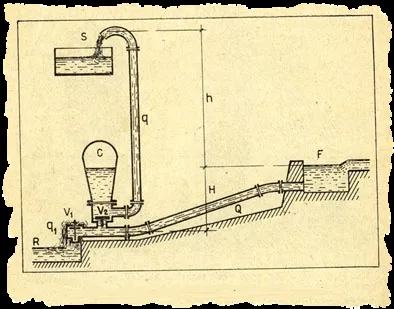
The “ram” pump, or “hydraulic ram” or “water hammer pump,” works using air pressure and the phenomenon of “water hammer,” which results in a sudden change in water pressure in a pipe. Using a few simple parts, pipes and valves, it is possible to create this system that pumps water to a considerable height without any external energy source.
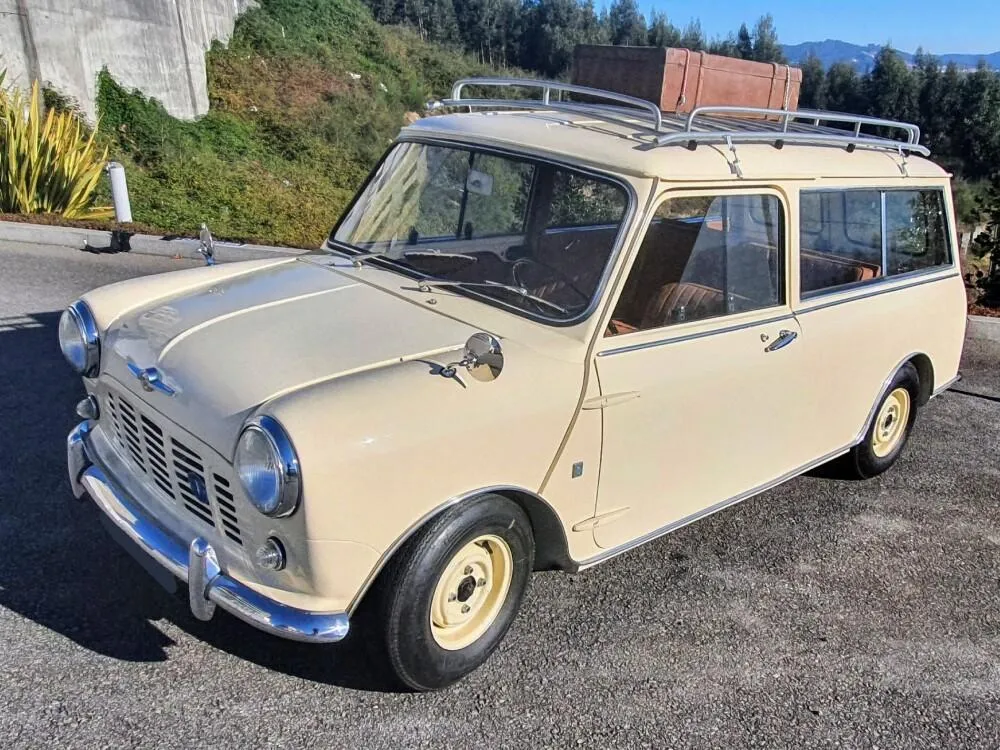
Eduardo: "He also had a beautiful Morris Mini van that he used for transport."
In those days there were Mini cars in the cities. My mother had a black Mini, which she was always careful to leave in a street going downhill, because on the coldest winter days the Mini sometimes wouldn’t start and we had to ask the neighbours for help to push the car.
But vans weren’t common, and even less so in a small town like Monchique. Eduardo continues: “He used the van to transport the jars containing the milk that was produced. He had a lot of cows and produced a lot of milk. They told me that once the engineer was driving his Mini van loaded with milk jugs and there was a long queue to cross the railway line. So the man overtook everyone and joined the queue first. Someone confronted him about the situation and the ‘crazy engineer’ replied, ‘So if all this milk goes bad, you’ll pay for it?’ And it seems they let him through.”
From the kitchen they call Eduardo, before he finishes with his eyes fixed on the horizon, visualising these memories. After a few minutes, he returns, “In the summer, the Quinta was full of people working, everything was in the area around the stream to make the silage. Everyone from Monchique was there and people from outside too, from many places,” he pauses and returns to the kitchen. The creek area is where the ruins near the stream currently stand.
Silage is a process carried out in spring or summer, when there is an abundance of organic matter. Its purpose is to preserve fodder that will later be used as food for livestock, especially at times like winter when there is a shortage of natural food for cows. This method consists of the lactic fermentation of plant matter, during which the pH drops to such low levels, i.e. very acidic, that the degradation process of the organic matter is interrupted. It is therefore a method of preservation, like a cattle food fridge.
Eduardo returns and continues: “For the silage, there was a big machine there [a part of it can still be found in the ruins today] to grind up all the organic remains of the oats and wheat crops. These pieces then went onto a conveyor belt where they were transported into the silo. Inside the silo was a man who put everything in layers. Hay and salt were added to each layer.” He pauses and laughs, “The crazy engineer always said to put in plenty of salt,” he laughs again and continues: “He said the cows liked it better, and then they drank more water and produced more milk. The truth is that in winter the cows ate it as if it were sweets.”
Eduardo pauses, another memory flashes in his mind’s eye, he pulls out his order form from each table, it was his way of gaining courage for the story that follows, and with a more serious expression he begins: “One of those silage summers, the foreman, who had worked at the farm for many years and knew very well how to use the silage machine, got his hand caught and lost a finger. It was all a matter of seconds. I don’t know if it was because of that episode or because of all the years he worked there, but the ‘crazy engineer’ offered him a mill,” he finishes with his eyes fixed on the ground.
The kitchen calls for him again. He returns with several plates for a table of six people. He returns to the table where I’m having lunch: “There was a cast-iron bathtub at the farm, which weighed an awful lot, and another one made of marble.” The cast-iron bathtub no longer exists, or at least it hasn’t been found. The marble bathtub, a true work of craftsmanship, is at the back of the house, in a small triangle-shaped garden.
As the conversation unfolds, out of the corner of my eye I see a gentleman sitting smoking cigarettes and always listening to the conversation. Sometimes he looks at me, and at first he seems suspicious. Eduardo continues and tells me that there are a lot of strawberry trees on the Quinta, and ends by saying: “My father-in-law knows a lot about it”.
His father-in-law, Joaquim Silva Duarte, who owns the restaurant (Recanto), was watching me from the start. He has a cigarette in his hand and is holding a lighter in the other. He looks me in the eye and starts: “There was so much medronho, something that would never end”. His eyes sparkle and his anxiety increases with the emotion of the memory. He lights his cigarette and, now calmer, continues: “In those days I had an alembic that I rented out. Everyone in the area had medronhos, but they didn’t have stills because they’re very expensive. Well, I didn’t just rent the still; I actually made the brandy. It was usually three or four days’ work. At Quinta I spent 20 days in the cellar! Everyday producing Medronho. It was incredible,” he ends with a proud smile.
He pauses for a smoke and continues, “The production was done in the winery, down by the river. The winery was to the left of that water dam. It’s from this dam that the water is pumped up here, directly to the water tower. That’s where I would set up my still and stay for days on end.” His eyes remained fixed on me and he added: “And of course, he would pay me for the work, as we had agreed, and after many litres and litres had been made, the engineer would give me a small bottle, which wasn’t even full, not even half a litre of brandy. The man was a real cheapskate,” he finishes, laughing.
Medronhal is where arbutus trees abound. Strawberry trees can be found throughout mainland Portugal, but especially in the Algarve hills. The abundance of this species is no coincidence: arbutus trees are very resilient to fires and have a great capacity to recover; their roots in a root system help to fix nutrients in the soil that are also available to other plants, thus making the soil richer and more fertile; their trunks are extremely compact and heavy, making arbutus firewood highly valued.
The most common and popular use of medronho in Portugal is to make medronho brandy through fermentation. It is thought that the production of this brandy began with the Arabs when they settled in the Algarve in the 10th century, in Monchique. Ten centuries later, in 1905, there were 61 brandy manufacturers in the town of Loulé (Faro district). In 1940, in Monchique alone, there were 55 stills and 3 liqueur companies.
As the afternoon progresses, customers finish their meals and leave the restaurant. Outside, on the terrace, under the leafy canopy of a tree, several tables are gathered. Soon it will be lunchtime for the waiters and cooks. After so many meals, it’s time to comfort the stomachs of those who served them.
Before Eduardo goes to lunch, he has one last story to tell: “Did you see the dog cemetery next to the house? Each grave had a stone with the dog’s name on it, all very well arranged. I and a lot of people had never seen such a thing!” On the east side of the house, where there’s a small triangular garden, that’s where the dog cemetery used to be. If a dog cemetery is rare nowadays, even more so on the side of a house, imagine in the 60s, 70s and 80s.
But this love of animals wasn’t just for dogs. In the upper part of the house, where the marble bathtub is located, there is a sculpture that also had the function of feeding the birds: a small shed on top where the food was placed from below, to protect it from the rain, so that the birds could eat.
Eduardo laughs at another memory: “The ‘crazy engineer’ didn’t like hunters. So when he heard them near his land, he’d grab a pistol and shout insults at them while firing shots into the air…”
The Serra de Monchique has a great diversity of flowers, eucalyptus, strawberry trees, rosemary, carob trees, various species of heather and a large population of bees. The Romans are said to have been the driving force behind beekeeping in Caldas de Monchique. Honey is extracted twice a year: at the end of spring flowering, in June or July, and at the end of winter flowering, in January. Summer honey is lighter in colour than winter honey due to the different blooms.
The farm has carob trees, eucalyptus trees, lots of strawberry trees, an orange orchard that used to be near the river, a wide variety of heather and, of course, lots of bees. This resource has not been forgotten and honey used to be produced. The bees also worked for the “crazy engineer”.
I finish lunch and Eduardo is getting ready to start his. Anabela, Eduardo’s sister-in-law, who also works in the restaurant, approached the table and said to me, “Talk to Mr Reis. His father was in charge at the Quinta and he lives right next door.”
I say goodbye to Eduardo and while thanking him for his kindness and availability, Anabela interrupts me and adds, “There’s a lady who lived in one of the houses in the ruins and is still alive. She worked there for many years and her name is Sofia. Her house is very easy to find…”. She then gives me directions. I thank her for her efforts to put me in touch with the right people. I leave and hit the road.
Reis, the foreman’s son
Reis, a resident of Monchique, lives near the craft shops on the roadside. He is the son of the caretaker of Quinta do Medronhal, where his father worked for several decades: “My father worked there and I would sometimes go to see him or help with something. And the engineer [Reis never referred to Frederico as a crazy engineer] had some three-phase generators near the entrance that were so big that it took two men to run them. Those generators were used on ships,” says Reis, as he watches a car pass by on the road.
I ask him if the cistern pumps weren’t enough to bring water from the stream and he promptly replies: “Probably, but he had several pumps”. He continues, “He also had a Daimler, a luxury car from an English brand that had never been seen here before. The car drove so much that he was afraid to drive it, so only the driver, António, drove it.”
Daimler was an English luxury car brand that supplied cars to the English royal monarchy. Later, in 1950, it lost this privilege and was overtaken by Rolls-Royce.
An episode came to mind: “They say that once the engineer was travelling with his wife through Trás-os-Montes in their Daimler, driven by António, the chauffeur. They were stopped by the GNR and, when the officers asked for his identity papers and car documents, Frederico answered them in English. The officers didn’t understand what he was saying. Frederico continued to speak to them in English, faster and faster, and the officer became so confused that he told them to keep going. António started the car and, further on, Frederico began to mock the police officers for being simpletons who couldn’t speak English.”
Reis pauses, looks at the horizon and returns to the conversation: “That pool at the Quinta was the first pool built in Monchique. It was built in 1960. The air-conditioning units were also installed at that time, nobody had heard of these things yet,” and he finishes while searching for the next memory.
It was in the middle of the 20th century, in 1930, that freon was developed, an aerosol that was incorporated into air conditioners. Until then, air conditioners were quite dangerous because they used a very flammable refrigerant gas. In 1950, the Carrier Corporation developed the first modern, safer air conditioners, and as production increased, their costs fell, and in addition to industry, they began to be used in homes. At Quinta do Medronhal they are still visible in the room to the west of the house.
The conversation continues and Reis’s memories come flooding back. He continues: “That green iron gate down here, on the main road, that was the main entrance to the Quinta and it dates from 1965 or 1966. There’s a letter M on the gate.” When I shared this story with Joshua, he took out a key ring from his pocket, which he was given when he bought the Quinta, and it has the same letter M as the one on the gate.
Reis continues, “You know, the man was also very fond of playing golf, he claimed to be a golfer.”
The first grass golf course in the Algarve opened in Portimão in 1966. It was no coincidence that Portimão was chosen. According to Revista Internacional, in 1940 Portimão was said to be the most modern city in the Algarve, and Praia da Rocha, the most sought-after by the Portuguese, already had some tourism from the English elite. The golf course, which opened in 1966, belonged to the five-star Penina Hotel, owned by Englishman John Stillwell. It was the hotel owner who invited Henry Cotton to design the golf course in a totally rural area.
The land was drained and more than 300,000 trees were planted. This work brought a lot of tourism, especially from Portuguese and English elites. They say that even today, more than 50 years later, it is still a modern and challenging golf course for professionals and beginners alike. Henry Cotton was a three-time British Open champion and one day, when he was in Portimão, he went to play a round of golf and bought a donkey from a local farmer. This donkey became his private caddie and was baptised with the name Pacífico. For years, at the Penina Hotel and Golf Course, Henry Cotton and his donkey, in fact his caddie, shared games with celebrities such as Bing Crosby, Bob Hope, Arnold Palmer, Jack Nicklaus, Tony Jacklin, Sean Connery and Lee Trevino. Now imagine the surreal image of a gentleman from the English elite walking around the green golf courses with a donkey carrying saddlebags full of golf clubs.
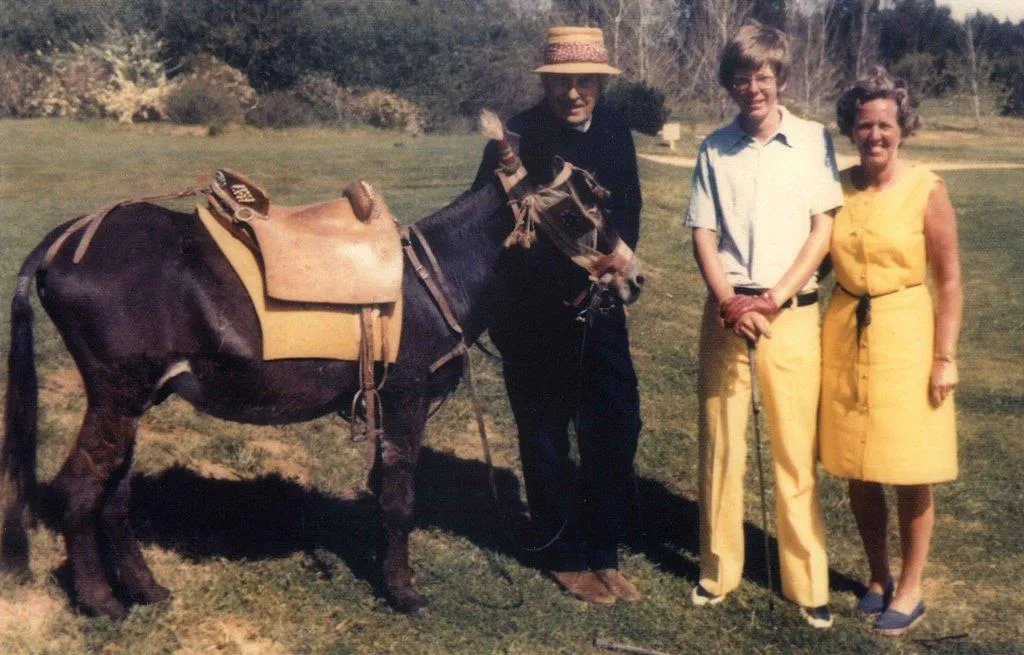
1970, Sir Henry Cotton and Pacífico
Reis continues with his historical precision: “And the engineer also had a connection with the Casino in Portimão, around 1940.” The land around the Quinta belonged to his relatives, and Reis told me: “He and his relatives were always in conflict. In fact, the engineer often had court cases. They were small things, but he almost always won. The guy wasn’t a fool at all. Many people called him crazy, but there was nothing crazy about him. He was a guy who knew what he wanted and knew how to get what he wanted.”
The conversation flowed like water, where the route is naturally created. Reis spoke again, “He also had a Land-Rover that he was very proud of. It was a beautiful jeep. He almost always wore a white jacket and shorts.”
Reis explains to me that the house that currently stands on the Quinta was inherited by Frederico. However, some changes were made: the air-conditioning, the water tank tower and the swimming pool. But the interior of the house has also been modified. On the east side, a room was added, the only room with a fireplace, which was built later. “Imagine in those days, a room with a fireplace was an eccentricity worthy of kings. Nobody was used to seeing such a thing.” He finishes with a smile. The wood used in the house, both in the cupboards and in the windows, reveals the English influences in the remodelling of the house.
Reis takes a little diversion from the Quinta’s history to tell me a curious story: “As you know, discos here in the Algarve have always been very famous in Portugal. And that was due to the British. At that time, around 1970, music from abroad took a year to reach Portugal. As more and more English people came here on holiday, they started bringing new records, freshly released, and playing them in the bars. And of course, that was a novelty and caused a furore. So they started bringing more and more music and, from the pubs, they moved on to the discos.”
Today, the British are the second largest community of foreigners living in Portugal. In 2023 there were around 42 thousand (the largest community is Brazilians, with around 205,000 people). Half of all British residents in Portugal live in the Algarve.
We return to the conversation about the Quinta and Reis talks about the machines we already know: the small tracked tractor, the pump to bring in water, the huge generators — and I ask him the following question, “How, in a country with so many restrictions on imports, did this man manage to bring all these innovations to Portugal?” and he replies, “So, he had a yacht, and that’s how he brought things in.”
I thank him for his time and availability and say goodbye to Reis. However, I’m left wondering about this last answer. Did Frederico transport his innovative acquisitions by boat from England to Portugal? It’s not a very short journey, nor is it very easy to navigate; on the contrary, it’s known for its currents and strong winds. The answer to this question would be found a few days later.
Before I get in the car and drive to Sofia’s house, I notice how calm the place is. There is always music that accompanies us, whenever we switch off the noise of our minds and allow ourselves to listen to the melody that nature has for us.
Sofia worked for Frederico and Rosemary for many years. She lived on the Quinta, in one of the houses that was on the river. Between the two bridges that cross the river, they are now just ruins, memories of other times. This was the information that Anabela (from the Recanto restaurant) had given me about Sofia.
Sofia, the woman who lived by the river
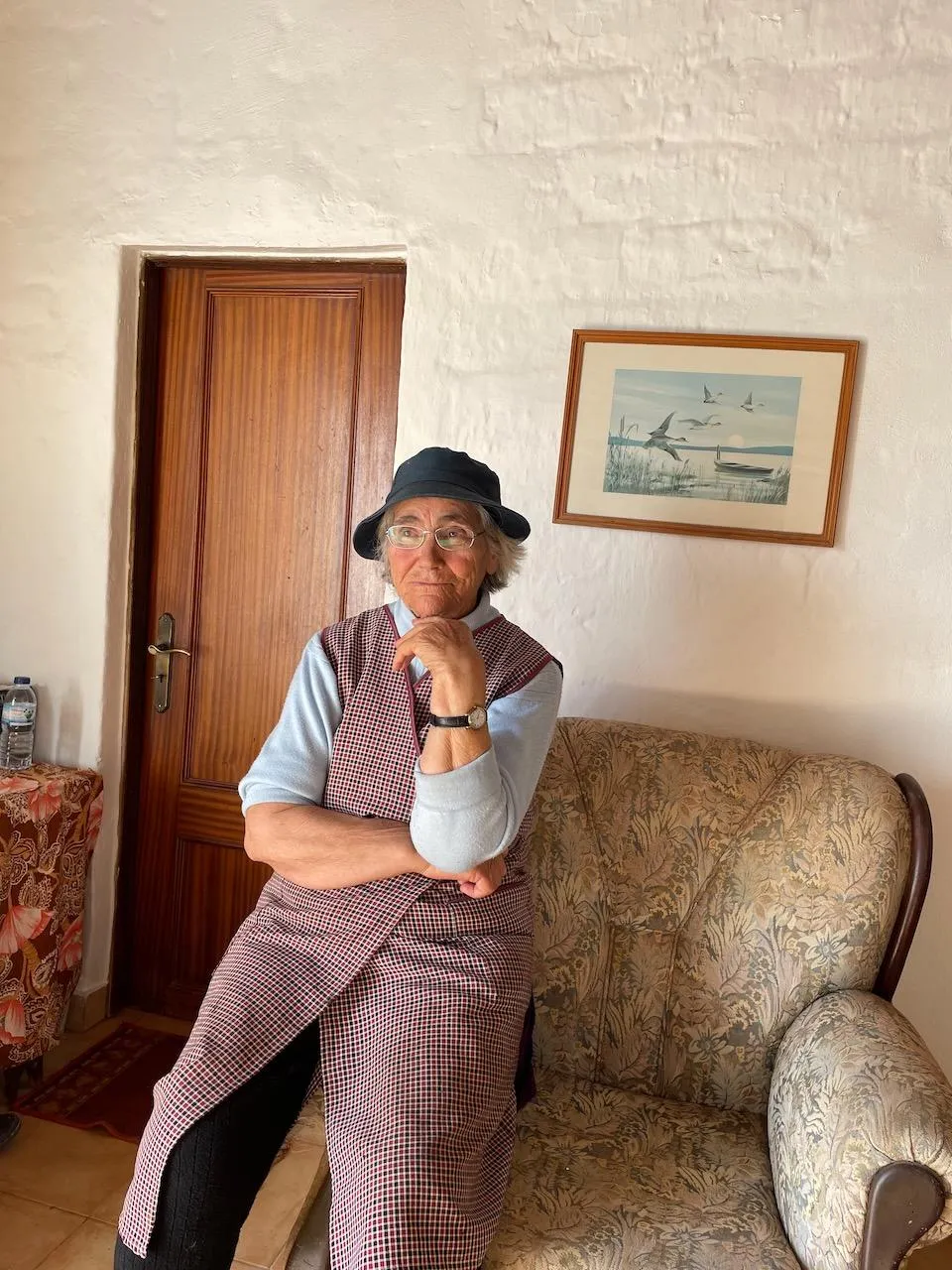
Sofia’s house is in a beautiful valley, surrounded by hills, many orchards, ploughed land and a few houses. The blue gate was open, I entered and two large dogs greeted me, barking loudly but restrained by their leashes. Sofia, wearing a hat and apron and short in stature, welcomed me with a warming smile.
Beyond the Quinta do Medronhal house, down below where a stream runs, are the ruins of what were once three houses and a cowshed. This area was called “Ribeira,” and it was in one of these houses, now the tallest ruin with a blue door, that Sofia lived with her husband and raised their three children in this small house.
Sofia begins: “I went there when I was 23 and left when I was 60, now look, I’ve spent a lifetime there,” she smiles humbly and continues: “My three children weren’t born there, but they were brought up there.” Sofia tended the gardens, growing wheat and oats and continued: “We worked seven days a week, we didn’t even have a day off. There was always a lot of work.” Her husband was responsible for the cows. Sofia explains: “Every day he woke up at 5.30 in the morning, and how many times did he ask me to help him wash the cows! When the vet came to inseminate them, he would always say that these were the cleanest cows in the Algarve,” and ends with a small laugh.
The cowshed was home to many cows, all dairy and of the Retinta breed. “Yes, a lot of milk was produced and all of it was sold to the cooperative. You couldn’t use the milk for anything else. Not even for newborn calves. When a calf was born, we used powdered milk, put the milk in a bucket, took the calves away from their mothers and they soon got used to drinking from the bucket.” She pauses and then adds, “The Old Man [that’s what Sofia called Frederico, by his surname] didn’t let anything go to waste.”
Sofia tells me about the moment at the Quinta when the electricity came on: “It was a party, everything was lit up. There was no need to carry petrol lamps, candles or lamps. Now, that was upstairs in the house, because down here by the river it was a different story.” I ask her if there was no light down by the river. “Oh yes, there was. But it was only for the cowshed. The old man was very tricky, he only let us switch on the lights when a calf was born at night. Every other night we had to keep using the oil lamps, even though there was light down there but he wouldn’t let us use them.”
Electricity made its debut in Portugal with the lighting of the Cascais Citadel on King Carlos I’s birthday in 1878. However, it wasn’t until the 1970s that electricity began to reach Portuguese homes. It was largely after 1974, with the fall of the dictatorship, that more public investment was made with the aim of lighting up rural areas as well as cities.
I ask Sofia about the other houses on the stream. “There were two houses, and then the cowshed, which was quite big. How is it now?” I tell her that only ruins remain, some without roofs. Sofia lets out a sigh and sadness fills her eyes, “It used to be so beautiful down by the stream. All the cobbled ground, the vegetable garden and the orange trees. Everything was always clean, the Old Man always wanted everything spotless. Not just their house, but also the gardens, the cultivated fields, everything had to be spotless. And all those leaves and sticks that were cleared from the paths and fields were used to heat the oven. You know, that oven next to the pool, I baked a lot of bread there. But for me, the most beautiful part of the farm was where I lived, ‘Ribeira’. And now you tell me it’s like this…”
There was nothing I could say to comfort her. I let the silence appease what was in her heart.
A few moments later, Sofia continues: “A lot of milk was produced there and then I had to walk with the milk jugs to the road to catch the bus to go to the cooperative in Portimão and sell the milk.” Eduardo told me that it was the engineer in his Mini Morris van who took the containers to the cooperative. I ask her and she replies: “That rarely happened, he always asked me to do it. And he didn’t want us to take the shortest route [the dirt track where you enter the farm by car today]. The land didn’t belong to him, it belonged to a cousin who got upset when he saw us driving past. But it was such a long way round and the pots were so heavy that I went anyway. They had their conflicts, but I had nothing to do with it, and going round with the pots was a lot of work for nothing.”
Sofia continues to describe those times to me: “Everything was planted, all the land was used to plant wheat and oats, even the steepest slopes. The oats and wheat were used to make feed for the cows,” and she finishes with an expression of pride in her work.
There is a pause and in the silence another memory emerges, and Sofia continues, “‘Ribeira’ was full of people in the summer, all working for the silage. The whole village was there. But one year, the foreman who worked there let his hand slip and lost a finger…”, she pauses with a sad expression, and continues, “He’s no longer alive today, that man is the father of the man you were talking to earlier, Mr Reis — his father, António Calhau.”
When Frederico Bívar da Costa died, his wife, Rosemary, suffered greatly, Sofia explains: “The old man died and it seems he took a piece of her. She was never the same again. Very still, very despondent. I thought my work was over. But then she asked me if I wanted to carry on working for her. Those were much calmer years, she was less demanding and gave me more rest. But it was a shame to see her like that, always down. Then one day she tripped and broke her arm, and spent some time recovering. Shortly afterwards she broke her foot, and it took even longer to recover. Then it was her hip. And then things got really complicated for her. She spent a lot of time in her flat in Portimão. It was around that time that the building work was done and many of the stairs at the back of the house [Quinta] were converted into ramps so that she could get around in her wheelchair. Even with all the difficulties of transporting her from Portimão to Quinta, she always made a point of coming several times.”
It was around this time that the Montaguit-Bívar Foundation was created. It was the foundation that managed the properties, and in 1998 part of the land was sold to what would become Omega Park, a zoo park.
Sofia also has records of those days at Omega Park, because she still worked for the owners. “Yes, Filipa [the owner of Omega Park] asked me to help her and I continued to do some work. It was less work but it was still something. But I was a very different person… Right at the entrance to the Quinta there were some very large pine trees, I remember, because I was always cleaning the floor because of the pine needles. Well, Filipa had those trees cut down,” she ends with an expression of pity.
Before I say goodbye to Sofia, I ask her one last question: “Was it good working with Frederico?”. Sofia lowers her gaze, pauses and raises her head again, looking me in the eye: “He never gave me anything more than what he paid me. I didn’t even get a day off. You know, we had a vegetable garden down by the stream that I tended, and he never let us take anything from it to eat.” I interrupt her to ask, “Where did you get your fruit and vegetables?”, and Sofia promptly replies, “We had to get them from outside the Quinta. Well, there was one time when my father was ill and I picked a few lettuces to take back, no more than three. The old man found out and gave me a hard time, all upset, and wouldn’t let me talk. When it was over and I could finally speak, I explained to him that the lettuces were not for me but for my father. The man cried like a baby and apologised profusely.” Sofia pauses and continues, “You know, I was hoping that he would leave me the little house where we lived in Ribeira, but nothing, he didn’t leave me anything…”
There is a sadness in Sofia’s eyes and voice: “I’ve never been back there, and now you’re telling me that it’s the way it is…” She pauses, her eyes fill with tears and she swallows them to tell me: “It was so beautiful. I can tell you that, for me, it was the most beautiful part of the Quinta…” and she finishes with a smile, accepting what life has given her.
I thank Sofia for her time and availability.
I drive to Caldas de Monchique. Park the car and walk for a while. There’s a stream that runs past the Águas de Monchique bottling plant. Next to the stream is a path. I walk along it. I remember the stories I was told today and the days before, mixed with the sounds of nature. This is a beautiful route, where the water is always on your side, you can hear the water running, smell the flowers and see the holes the wild boars make in the ground at night. Before the end of the day I return to the Quinta in time for the last sunset of my stay.
The mystery of Frederico
During conversations with Eduardo, his father-in-law Joaquim Duarte, Reis, the foreman’s son, Sofia, the lady who lived in one of the now ruined houses on the riverbank, João who works in the quarry, and others I met without ever knowing their names, there was something that didn’t make sense in my head. Frederico brought in a lot of imported machinery. Portugal was living under a dictatorship with high taxes on all imported goods. Until, one late afternoon, while I was watching the orange trees and the bees going from one place to another, I remembered a story Eduardo had told me:
“He [Frederico] once asked me to go to Praia da Rocha with him. And I went, he paid, I was a kid, I could use all the money. When I got to the beach I saw a boat, it was his boat. At that time there was no marina, the few boats there were anchored right in front of the beach. A man brought the boat close to the beach and the ‘crazy engineer’ told me to start unloading. And off I went. As soon as I asked him the first question, he told me to shut up and said ‘it’s for unloading, it’s not for asking questions’.”
It’s true and well known that there was a lot of smuggling in those days, but there was something that didn’t make sense: was Frederico travelling with his boat from Portimão to England? That wouldn’t be an easy journey to make. There was something missing from this story.
Later, I remembered that Reis had mentioned something about Gibraltar, and somehow that information seemed to be close to solving this enigma. That evening, my last at Quinta do Medronhal, in the company of Joshua and a glass of wine, I told him about the day’s progress. Specifically, I shared my enigma: dictatorship, very expensive imported products, a boat, Praia da Rocha, smuggling, Gibraltar and I was missing a piece… As soon as Joshua heard this sequence, he quickly told me, “A part of Gibraltar belongs to England,” and that was it.
In all probability, Frederico Bívar Velho da Costa would buy the machinery from English companies and have it delivered to Gibraltar. Then, with his boat and just a few hours of calm travelling, without many currents or strong winds, he made the crossing, loaded his boat and then unloaded it at Praia da Rocha, in the heart of Portimão. In this way, he brought machines that had never been seen in these lands into Portugal, away from the eyes of the police.
Frederico Ribeiro Neves de Bívar Velho da Costa was not only an engineer, an animal lover, a pioneer in the construction of a swimming pool in Monchique, one of the heirs to the Bívar Velho da Costa family, a major milk producer in Monchique, a golfer, a member of the Portimão casino, a producer of honey and a lot of medronho brandy.
— Text by Diogo Henriques. 2024.